- In 1979, I hitchhiked across the USA -- from Massachusetts to California, then up the coast to Oregon and down to Arizona. This sounds dangerous, but we met lots of very nice people, especially in the heartland. The only time we had anything like trouble was when we got a ride from a weird guy in Reno, Nevada. He promised to take us to Phoenix. Instead we drove around Nevada so he could say goodbye to his friends. When we were just outside Las Vegas, he stopped the car and said, "I just remembered. I can't go to Arizona. I'm wanted there." He left us in the desert and drove back in the direction of Reno.
- The first new car I bought was a 1983 Honda Civic Wagon. It had a 5-speed manual transmission. When I picked it up at the dealer in Tewksbury, Mass., I had absolutely no idea how to drive a manual transmission car. Somehow I drove it about 30 miles to Gardner, Mass., where my father taught me how to use the clutch and shift. I have driven "a stick" ever since.
- I once slept on the streets of Lowell. In the early 1980s, mortgage rates got as high as 18%. Housing prices were relatively low, but the interest rates were a huge barrier for first time home owners. The state of Massachusetts subsidized a limited number of low-interest loans on a first-come-first-served basis. The state gave 24 hours notice of the availability of small pools of these loans. When I heard about some loans becoming available the next day in Lowell, I grabbed my sleeping bag, drove to downtown Lowell, and camped out in front of the bank for the night. I think I was second in line, but by sundown there was a queue of twenty people. It was fun night and, thanks to the Commonwealth of Massachusetts, a small price to pay for becoming a homeowner.
- I've never bought a lottery ticket and I never will.
- I've worked full-time as a software engineer for 25 years, but it wasn't my first career choice. When I was in high school I wanted to be an architect. Usually, that meant going to a liberal arts school and then on to graduate school in Architecture. For some reason, I thought it would be better to get a degree in Civil Engineering first. I also took summer jobs working in a steel fabrication plant, at the Army Corp of Engineers, pouring concrete. I thought an architect should understand the materials, project planning and engineering before he started sketching buildings and bridges. In retrospect, I was naive. Mature industries like construction tend toward specialization rather than generalization. In any case, after undergraduate school I drifted into Software Engineering. I found a home in a very young industry, where generalists were still valued. Over time, I learned to be a software architect, but I still get to build software when I want. In a way, I've ended up exactly where I planned.
Thursday, January 11, 2007
Five Things You Didn't Know
Pete tagged me to participate in the "Five Things You Didn't Know about Me" game. I'll play along:

Thursday, January 04, 2007
New Hampshire Photos on Flickr

Photo by Tim Somero
I've been knocking around Flickr for about a year now, but I never really felt plugged into the community. Flickr is just so big. However, I recently discovered some cozier communities within Flickr.
The New Hampshire group has about 350 members interested in photographing (or just viewing photos of) the Granite State. The group is very active. Many members contribute photos to the group and there are even a few organized projects. For example, the Cupolas, Steeples & Vanes project is busy capturing some of New Hampshire's unique architectural features. The New Hampshire group even has a separate blog . The New Hampshire Photo Tour blog highlights the best work in the group.
Even closer to home for me is the Souhegan Valley group. This group has only fourteen members, but I think their photos are very good.
If you appreciate the beauty of New Hampshire, check out all the links above. If you have another passion -- from Architecture, to Cows, to the Red Sox - try searching all the groups on Flickr. You're bound to find a group that's more your cup of tea.
Wednesday, December 20, 2006
Random Flickr Links

Photo by Ali Khurshid
Photography is a powerful medium. In the past few years, because of the availability of cheap digital cameras and the incredible popularity of Flickr, the medium has become more powerfully democratic. Now professionals and amateurs alike can share their work with the whole world -- with very little interference from governments or big media. When I explore photos on Flickr, the world seems a lot smaller. Here are just a few of the most compelling examples:
- Tom Stone is a documentary photographer "known for his portraits of people living along the edges of society". His Poverty set on Flickr is an unflinching look at the homeless of San Francisco.
- Ali Khurshid was recently profiled in Time magazine. His set, The Shadows They Draw, is a collection of dreamy images from one beach in Karachi, Pakistan. Words fail me on this one. You have to check out Khurshid's beautiful photos.
- The 365 Days pool contains self-portraits of many Flickr members. Each contributor has committed to uploading a self-portrait once a day for a whole year. Honestly, I don't know why anyone would consider such a project. This is definitely a mixed bag, but there are some really interesting ideas here.
Tuesday, December 12, 2006
Favorite Christmas Songs
Pete challenged me and others to list our five favorite Christmas songs. This is very difficult. I could probably list a dozen favorite Christmas Carols. They all bring back memories. And then, of course, there are some great Christmas pop tunes and novelty songs. So without further ado, here's my list (although it might change tomorrow):
- Go, Tell It on the Mountain.
- Anything from the soundtrack of A Charlie Brown Christmas, but Skating is my favorite. You know this one. It is the song where Vince Guaraldi's piano evokes snowflakes falling.
- What Child is This? because it has the same tune as Greensleeves.
- Carol of the Bells or anything else from George Winston's December.
- Let it Snow. This is one of the few songs I will attempt to sing when other people are around. I can't help it.
Saturday, December 02, 2006
World's Largest LEGO Construction
This week, the SEE Science Center in Manchester, NH unveiled the world's largest LEGO construction. It is a three million brick, period replica of Manchester's Amoskeag Mill. It was built by the SEE Science Center and the New England LEGO Users Group. Check out this video courtesy of WMUR-TV.
Thursday, November 30, 2006
The Writer's Almanac
"It's the birthday of the man who wrote under the name Mark Twain, Samuel Langhorne Clemens, born in Florida, Missouri (1835)..."So says today's online edition of The Writer's Almanac. You may have heard the inimitable Garrison Keillor read The Writer's Almanac on National Public Radio. Since I am not always able to catch the radio edition, I've recently pointed my browser's home page to the online edition. Now I am more likely to get my daily dose of literary birthdays and historical notes. (Who knew David Mamet, Jonathan Swift and Mark Twain were all born on November 30?)
I also get to read a new poem each day. I've really enjoyed the selections lately. On the web or on the radio, I highly recommend The Writer's Almanac.
Wednesday, November 22, 2006
Tabblo 2.0

Just six months after it was first made available to the public, Tabblo has gotten a substantial face-lift. It may not exactly be "Tabblo 2.0" (those are my words), but I think it is worth a look.
If you haven't visited Tabblo recently, here's a quick summary:
- It's a photo sharing site on steroids. In addition to uploading photos, you can organize your photos on a page that tells a story -- a "tabblo". Here's a shameless plug for the tabblos I've created.
- If you are a big fan of Flickr, you might be saying, "That's nice, but I already use Flickr to share photos. I don't want to leave the Flickr community." Well, you don't have to leave Flickr because Tabblo can automatically access the photos you upload to Flickr. For me, Flickr has become the "shoebox" where I put my best photos. Tabblo is where I go to organize the photos into "albums".
- Tabblo is a growing community of photographers and artists. Let me stress the word artists. I am amazed at the work other Tabblo folks are doing. I really feel privileged to be part of the Tabblo community. As a Tabblo member, you can comment on other people's tabblos, invite people to view your tabblos, or join groups of like-minded Tabblo members. In my opinion, Flickr can be a bit intimidating. The Tabblo community is still relatively small and vastly more fun.
- Tabblo is advertisement free and, unlike Flickr, they don't charge for a "pro" account. So what is Tabblo's business plan? I guess they plan on making money on posters, postcards, prints, and eventually, books. You can order a poster-size print of any of your on-line tabblos and you can now create tabblos specifically designed for postcards. While I haven't tried the postcard feature, I can testify that Tabblo posters are wonderful. I recently ordered a poster of one of my tabblos. It was inexpensive and arrived just a few days after I placed the order.
Update: According to Ned, Tabblo supports printing books as of now. That was quick. :-)
Thursday, November 09, 2006
A Big Surprise
Once in a while,For more of Donald Rumsfeld's poetry, see Hart Seely's article at Slate.com.
I'm standing here, doing something.
And I think,
"What in the world am I doing here?"
It's a big surprise.
-- Donald Rumsfeld
Tuesday, October 31, 2006
Eclipse Rules
Eclipse must be doing very well. I can tell because there is now at least one blog entirely dedicated to listing all of the problems with Eclipse. By comparison, I can't find any blog or website dedicated to NetBeans complaints.
It may seem counter-intuitive that one's vocal critics are a measure of one's success, but consider the case of author Dan Brown. In an interview on NHPR, Brown talked about the uproar over The DaVinci Code. He was initially surprised by the volume of criticism. After all, his earlier book, Angels and Demons, was just as controversial, but it didn't generate anywhere near the same number of objections from readers. Brown's mathematician father explained all by pointing out a simple fact: The audience for the earlier book was a tiny fraction of those that read The DaVinci Code. You can't please everyone, so statistically speaking, lots of complaints might just be a sign you are a smash hit.
Taking the Eclipse vs. NetBeans comparison a step further, try comparing the number of Google hits for these two phrases: "eclipse sucks" and "netbeans sucks". Using Googlefight to do the comparison, I recorded 1840 hits for the Eclipse phrase vs. 421 hits for the NetBeans phrase. Knowing what I know about Eclipse, I'm sure this doesn't mean Eclipse is four times worse than NetBeans. More likely, it's an indication that Eclipse is four times more popular.
It may seem counter-intuitive that one's vocal critics are a measure of one's success, but consider the case of author Dan Brown. In an interview on NHPR, Brown talked about the uproar over The DaVinci Code. He was initially surprised by the volume of criticism. After all, his earlier book, Angels and Demons, was just as controversial, but it didn't generate anywhere near the same number of objections from readers. Brown's mathematician father explained all by pointing out a simple fact: The audience for the earlier book was a tiny fraction of those that read The DaVinci Code. You can't please everyone, so statistically speaking, lots of complaints might just be a sign you are a smash hit.
Taking the Eclipse vs. NetBeans comparison a step further, try comparing the number of Google hits for these two phrases: "eclipse sucks" and "netbeans sucks". Using Googlefight to do the comparison, I recorded 1840 hits for the Eclipse phrase vs. 421 hits for the NetBeans phrase. Knowing what I know about Eclipse, I'm sure this doesn't mean Eclipse is four times worse than NetBeans. More likely, it's an indication that Eclipse is four times more popular.
Tuesday, October 17, 2006
Vast Centrist Conspiracy
We have been listening to the thunder of partisan politics for so long, it can be difficult to hear the moderates speak. Is it just me, or are the moderate voices getting louder? Here are just a few I've heard lately:
I'm afraid both major parties have already nominated candidates from the fringes. It may be too late to inject reason into the mid-term elections, but I'm hoping for a vast centrist conspiracy to take hold in 2008.
- Lou Dobbs on why the middle class needs to fight the politics of polarization.
- James Baker (R) and Lee Hamilton (D) chair a bi-partisan panel looking for alternatives to resolving the war in Iraq.
- John Danforth (R) on saving the Republican Party from right wing conservatives.
- Sam Harris (D) on saving the Democratic Party from head-in-the-sand liberals.
I'm afraid both major parties have already nominated candidates from the fringes. It may be too late to inject reason into the mid-term elections, but I'm hoping for a vast centrist conspiracy to take hold in 2008.
Monday, October 16, 2006
Fall Foliage
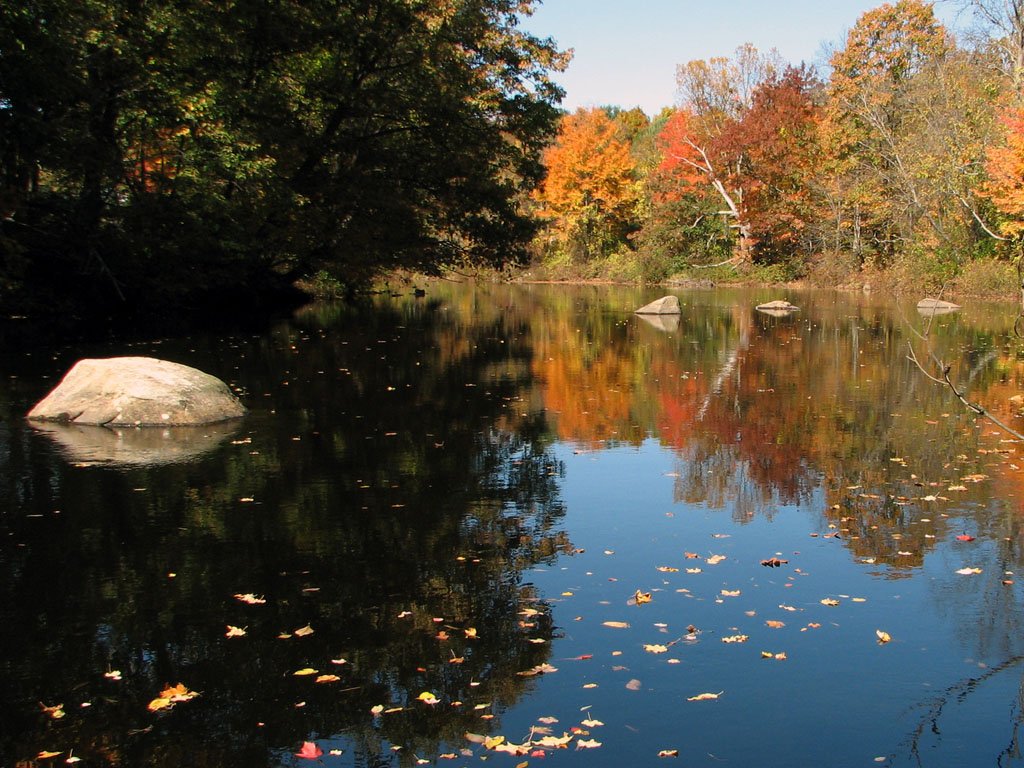
According to this online foliage report, southern New Hampshire foliage peaked this past weekend. We got our first hard frost on Friday night, so the leaves will be past peak before you know it.
As I scurried around doing errands this weekend, I kept my camera with me and got some nice shots. See my Fall Foliage tabblo for some samples.
Thursday, October 12, 2006
Blogger Beta
I just discovered Blogger has some big changes available in Beta. One feature I've been waiting for is tags. They are in the list of Beta features, but of course Blogger calls them labels -- just like labels in Gmail. To get label support you have to upgrade to the Beta and switch to a new template system called layouts.
So I've taken the big leap. This blog will be under construction while I try on different layouts and slowly bring back some of the customizations I did to my old template.
So I've taken the big leap. This blog will be under construction while I try on different layouts and slowly bring back some of the customizations I did to my old template.
Wednesday, October 11, 2006
You Learn Something New Every Day
 This past weekend, my thirteen-year-old son and I completed the New Hampshire Fish and Game Department's Hunter Education course. This is a sixteen-hour course required by the state. You can't get a hunting license unless you present a certificate proving you have completed the course.
I am not sure I will ever get a hunting license or go hunting. We took the course because my son is absolutely crazy about hunting. I don't know how it started, but he has worked incredibly hard at this. He has devoured books and videos on the topic. He spends hours in the woods looking for deer sign. And he easily completed the hunter education course.
Although I was ambivalent about hunting at the start, I am very proud of my son and I'm glad I tagged along. I've known hunters all my adult life. I certainly respected the hunters I know, but I guess I had acquired the prejudice that most hunters are yahoo rednecks. I thought my friends were exceptions to the rule. Having spent hours over the past few weeks with dedicated volunteer instructors from our local fish and game club, I'm convinced my prejudice was unfounded. These guys are serious about their sport and committed enough to spend hours of their own time to help others learn. They are especially passionate when teaching hunter safety and ethics.
Yes, there are yahoos out there, and you will certainly hear about hunting accidents this Fall, but please don't assume the guys in blaze orange are idiots. Maybe they're not from your tribe, but they deserve your respect.
Wednesday, October 04, 2006
Ten Favorite Songs
Picking up the thread from Pete, here's a list of my ten favorite songs:
- Workingman's Blues #2
- Ain't Talkin'
- When the Deal Goes Down
- Spirit on the Water
- Beyond the Horizon
- Nettie Moore
- Someday Baby
- Thunder on the Mountain
- Rollin' and Tumblin'
- The Levee's Gonna Break
Monday, October 02, 2006
Applefest Half Marathon

It was beautiful weather for the Applefest Half Marathon this weekend. I worked at one of the water stations and took lots of pictures.
This tabblo features a few of the many Applefest runners and this tabblo is a behind the scenes look at what makes Applefest so unique.
Monday, September 11, 2006
Charles River Scenes
While I was in Cambridge last week, I walked along the Charles River and took lots of photos. If you're interested see my Charles River Scenes set on Flickr.

EclipseWorld Wrap Up
Friday, September 8 was the last day of the EclipseWorld technical conference. I won't go into all the gory details of the sessions I attended. If you read my Day Two report, it was more of the same: Some sessions missed the mark, at least for me. These sessions just weren't technical enough. In fact, in an informal poll, the consensus among people who have attended both conferences is that EclipseCon is the better conference for experienced Eclipse developers.
Of course, the conference did have some good sessions. The best session I attended on Friday was called Contributing Code to Eclipse. How to. Why to. It was conducted by Bjorn Freeman-Benson, Director of the Open Source Process at the Eclipse Foundation. Bjorn described the organization of the Eclipse Foundation, the motives of it's member companies *, and the details of development process.
As Bjorn puts it, one measure of the Eclipse project's success is they have released a version of Eclipse every year, on schedule, for the past seven summers. This is a record of which most commercial software companies would be proud, but Eclipse is an open source project. You might have expected it to disintegrate into anarchy by now.
How has the project managed to be so successful? Bjorn highlighted three points:
* Eclipse Foundation members commit resources to Eclipse projects not out of altruism. They expect to make money on the Eclipse framework.
Of course, the conference did have some good sessions. The best session I attended on Friday was called Contributing Code to Eclipse. How to. Why to. It was conducted by Bjorn Freeman-Benson, Director of the Open Source Process at the Eclipse Foundation. Bjorn described the organization of the Eclipse Foundation, the motives of it's member companies *, and the details of development process.
As Bjorn puts it, one measure of the Eclipse project's success is they have released a version of Eclipse every year, on schedule, for the past seven summers. This is a record of which most commercial software companies would be proud, but Eclipse is an open source project. You might have expected it to disintegrate into anarchy by now.
How has the project managed to be so successful? Bjorn highlighted three points:
- It's a meritocracy. Only the best developers become Eclipse committers. Even a paying foundation member company cannot install one of their developers on a project without approval from the current committers. Generally, you become a committer by contributing patches first.
- The process is completely transparent. Everything from project planning, to staffing, to the actual source code is recorded on the Eclipse web site. This ensures that both committers and the eventual consumers know what is happening with the project.
- Communication is key. This is related to the point about transparency, but Bjorn highlighted it a few times. He said even a great developer will not succeed in an Eclipse project unless he is also a good communicator.
* Eclipse Foundation members commit resources to Eclipse projects not out of altruism. They expect to make money on the Eclipse framework.
Thursday, September 07, 2006
EclipseWorld, Day Two
For me, today was Rich Client Platform (RCP) day at EclipseWorld. I planned on attending four separate sessions on RCP. As it was, I took a small detour to learn about the Java profiling tools in the Test & Performance Tools Platform (TPTP).
The first RCP course was First Steps for Building Eclipse RCP Applications. It was mostly review for me, but I thought it would be good preparation for some of the more advanced courses. The instructor, Dwight Deugo, did a good job describing the basics.
I also attended Fundamentals of RCP UI Programming. This session was a little disappointing. The instructor is a good speaker, but he spent the entire two hours talking about JFace -- and from a very high level. Although he occasionally showed some sample code, it was difficult to follow along. The sample code wasn't reproduced in the presentation materials. Even though I was near the front, I couldn't see the details. Pity the poor folks in the back.
To complete "RCP day", I planned on attending a two part session called Successful Architecture Design for RCP Applications. I expected this to be about factoring your RCP application into features, plugins and fragments; interactions between views and editors; extension points; the job manager; and other hard-core Eclipse concepts. Ten minutes through the first part, I realized I was mistaken. The session was all about migrating three-tier business applications from the web to RCP. Although the instructor has good "Eclipse credentials", this topic didn't really fit with the other sessions in the RCP track. It certainly doesn't interest me personally.
Rather than sit through the second part of Successful Architecture, I decided to switch to Profiling Java Application Behavior with Eclipse TPTP. This was a revelation. The instructor demonstrated the features of the Profiling and Logging perspective which is contributed to Eclipse by TPTP. The profiling views let you track execution flow, execution statistics, memory statistics and object references in a running JVM. You can quickly sort these views to find hot spots like methods that consume lots of CPU cycles. I use Eclipse everyday but I didn't realize the free profiling tools have gotten this good. For a good introduction of the Profiling and Logging perspective, see this tutorial at eclipse.org.
The first RCP course was First Steps for Building Eclipse RCP Applications. It was mostly review for me, but I thought it would be good preparation for some of the more advanced courses. The instructor, Dwight Deugo, did a good job describing the basics.
I also attended Fundamentals of RCP UI Programming. This session was a little disappointing. The instructor is a good speaker, but he spent the entire two hours talking about JFace -- and from a very high level. Although he occasionally showed some sample code, it was difficult to follow along. The sample code wasn't reproduced in the presentation materials. Even though I was near the front, I couldn't see the details. Pity the poor folks in the back.
To complete "RCP day", I planned on attending a two part session called Successful Architecture Design for RCP Applications. I expected this to be about factoring your RCP application into features, plugins and fragments; interactions between views and editors; extension points; the job manager; and other hard-core Eclipse concepts. Ten minutes through the first part, I realized I was mistaken. The session was all about migrating three-tier business applications from the web to RCP. Although the instructor has good "Eclipse credentials", this topic didn't really fit with the other sessions in the RCP track. It certainly doesn't interest me personally.
Rather than sit through the second part of Successful Architecture, I decided to switch to Profiling Java Application Behavior with Eclipse TPTP. This was a revelation. The instructor demonstrated the features of the Profiling and Logging perspective which is contributed to Eclipse by TPTP. The profiling views let you track execution flow, execution statistics, memory statistics and object references in a running JVM. You can quickly sort these views to find hot spots like methods that consume lots of CPU cycles. I use Eclipse everyday but I didn't realize the free profiling tools have gotten this good. For a good introduction of the Profiling and Logging perspective, see this tutorial at eclipse.org.
Wednesday, September 06, 2006
EclipseWorld, Day One
I'm at the EclipseWorld technical conference in Cambridge this week. I was hoping to blog from the conference, but there were technical problems with the conference's wireless network today. There are only a few hundred attendees, but the organizers apparently didn't plan for a large volume of network traffic. This doesn't reflect well on the conference.
Today, we each had to choose one of seven all-day tutorials to attend. I attended the Callisto Boot Camp:
Today, we each had to choose one of seven all-day tutorials to attend. I attended the Callisto Boot Camp:
This tutorial, for experienced Eclipse developers who are currently using Eclipse 3.1, will deep-dive on the new features and innovations in each of the 10 projects that make up the Callisto Simultaneous Release. By attending this class, you'’ll gain a unique perspective on these projects, not only about the individual new functions that they offer, but how they integrate together to advance the entire Eclipse ecosystem. Everything you want to know about Callisto--—you'’ll find it here.The instructor -- Eclipse Evangelist, Wayne Beaton -- acknowleged from the start it is difficult to do a deep-dive on everything. For my taste, he spent a little too much time on the Web Tools Platform (WTP) and not enough on the C/C++ Development Tools (CDT) or Data Tools Platform (DTP). However, I'm not really criticizing. Mr. Beaton struggled mightily to describe the whole elephant. He didn't quite pull it off, but he demonstrated a solid understanding of a broad set of technologies. It was a worthwhile overview.
Tuesday, September 05, 2006
Milford Labor Day Parade
Admit it. You have been desperately waiting for pictures from the 2006 Labor Day Parade. See my Milford Labor Day Parade tabblo for exclusive photos.


Subscribe to:
Posts (Atom)